
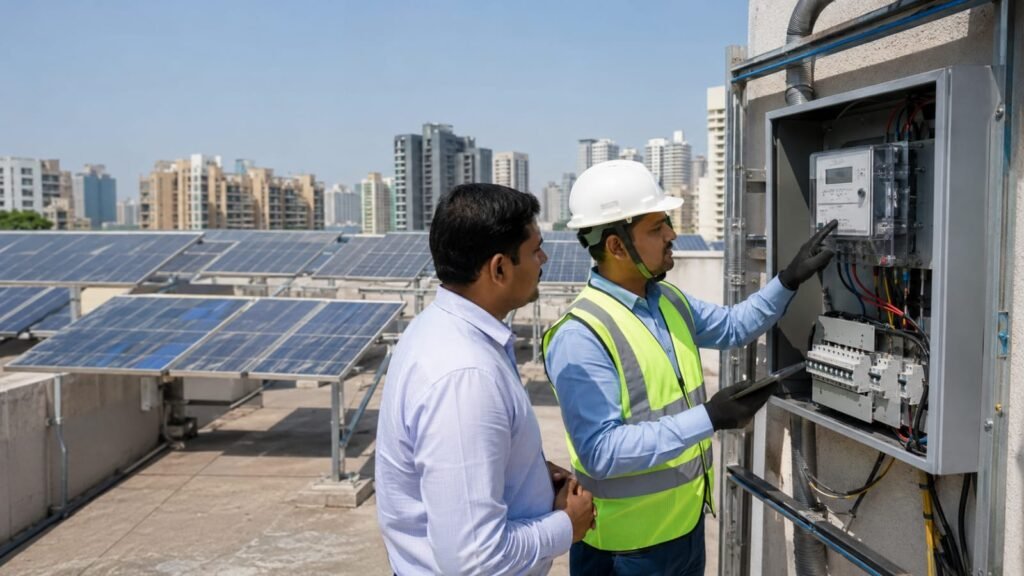
A housing society can install an excellent rooftop solar plant and still face billing confusion if the metering route is not decided at the planning stage. The common question is simple: when the plant produces more electricity than the building is using at that moment, where does the excess go and how does the society receive credit?
Net metering answers that question. However, the application depends on the consumer connection, distribution company, sanctioned load, approved capacity and the purpose of the solar plant. For a housing society in Mumbai, these details should be resolved before equipment is ordered.
What Net Metering Means for a Housing Society
In a grid-connected system, rooftop solar and the utility grid work together. Solar generation first supports the connected electricity demand. When generation is lower than consumption, the grid supplies the balance. When generation is higher, eligible surplus electricity flows to the grid through an approved bidirectional meter.
The meter records import and export separately. The distribution company then applies credits according to the prevailing regulations and billing method. Net metering does not mean that the grid stores electricity physically for the society. It is an accounting arrangement measured through the approved meter.
Which Electricity Meter Will Receive the Solar Connection?
This is the first decision. Most housing society projects are designed for the common-area connection that serves lifts, water pumps, corridor lighting, parking areas, security systems and shared amenities. In that case, the society is normally the applicant and the solar plant is mapped to the relevant common meter.
If the objective is to distribute solar benefits to individual flats, the project may require group or virtual metering provisions where available. That route involves a different allocation and documentation process. It should not be promised until the applicable DISCOM confirms eligibility and procedure.
A consultant should inspect the latest electricity bill, consumer number, tariff category and sanctioned load before preparing the proposal.
Step 1: Complete the Technical and Rooftop Assessment
The society should finalise a realistic capacity using electricity consumption, common-load behaviour, rooftop area and structural feasibility. A preliminary single-line diagram, module layout and equipment plan are then prepared.
The system must fit the consumer connection and protection requirements. Submitting an arbitrary capacity often creates avoidable revisions during feasibility review.
Step 2: Pass the Society Resolution and Organise Documents
The managing committee should place the project before the appropriate society meeting and document the approval. The resolution should identify the rooftop area, intended meter, project model, authorised signatory and permission to complete the application.
Typical documents may include society registration records, identity and authority documents, recent electricity bills, property or occupancy documents, committee resolution and technical proposal. The final list must be checked on the applicable portal because requirements can change.
Clear internal approval prevents disputes after the application has already entered technical processing.
Step 3: Submit the Feasibility Application
The application is submitted through the relevant distribution company or approved rooftop-solar portal. In Mumbai, the provider may vary by location. MSEDCL solar net metering procedures should not be copied blindly for a society served by another distribution company.
The utility reviews the connection, sanctioned load, transformer or network feasibility, proposed capacity and technical documents. If clarification is requested, the EPC team should respond with corrected drawings or information rather than proceeding on assumptions.
Procurement before feasibility confirmation can expose the society to capacity changes or equipment mismatch.
Step 4: Install the Plant According to the Approved Design
After approval, the EPC contractor installs the modules, mounting structure, inverter, cables, earthing, lightning protection, isolators and electrical panels. Equipment selection and installation must match the approved documents and applicable standards.
The system should be tested internally before requesting utility inspection. Labels, protection settings, cable routes and access areas must be complete. A rushed inspection request often results in repeat visits.
Step 5: Inspection, Meter Installation and Synchronisation
The utility or authorised agency inspects the installation and verifies compliance. The existing meter may be replaced or supplemented with an approved bidirectional meter depending on the process.
Only after the required approvals and synchronisation should the plant operate in grid-connected export mode. Switching on an unapproved export system can create safety, compliance and billing problems.
How the Electricity Bill Changes
After commissioning, the bill reflects imported and exported units according to the approved metering arrangement. The society should compare the first few bills with inverter-generation records. The two figures will not always be identical because on-site solar is consumed before export, while the meter records exchange with the grid.
The committee should track generation, import, export and total common-area consumption. A sudden gap can indicate shading, equipment downtime, communication failure or a billing issue.
Common Net-Metering Mistakes
One frequent mistake is applying through the wrong consumer connection. Another is selecting plant capacity without checking sanctioned load. Societies also lose time when the resolution does not authorise the signatory or when technical drawings do not match the installed system.
Some committees assume that every flat will automatically receive a lower individual bill. A common-meter system usually reduces the society’s shared electricity expense. Individual credit requires a specifically approved arrangement.
Who Should Manage the Application?
A competent solar installation company in Mumbai should coordinate the technical application, documentation, drawings, inspection support and commissioning. The society must still review and sign official documents; the EPC contractor cannot replace the society’s legal approval.
Rising Sun Electric provides end-to-end support for rooftop assessment, system design, net-metering coordination, installation and handover for Mumbai housing societies.
Frequently Asked Questions
Is net metering compulsory for a housing society solar plant?
It is generally required when a grid-connected system exports surplus electricity. The exact arrangement depends on the approved system and distribution company.
Can one solar plant reduce every flat’s electricity bill?
Not automatically. A plant connected to the common meter primarily offsets common-area electricity. Individual allocation requires an approved group or virtual metering framework.
Does the society need approval before installation?
Yes. Society authorisation, utility feasibility and technical approvals should be completed as applicable before the plant is commissioned.
Why is inverter generation different from meter export?
Some solar electricity is consumed directly by common loads before it reaches the utility meter. Export represents only the surplus sent to the grid.
Can the EPC contractor apply for the society?
The contractor can prepare and coordinate the application, but the society remains the consumer and must provide authorised documents and approvals.
Conclusion
Net metering should be designed with the solar plant, not added as an afterthought. When the correct meter, capacity and documentation are selected early, the society receives a smoother approval process and clearer billing. Rising Sun Electric helps housing societies in Mumbai manage the complete technical and coordination process.

Sahil Doshi is the Director of Rising Sun Electric with over 10+ years of experience in solar energy and energy conservation. He began his professional journey in Mumbai in 2015 and has since worked on commercial, residential, and industrial solar projects.
