
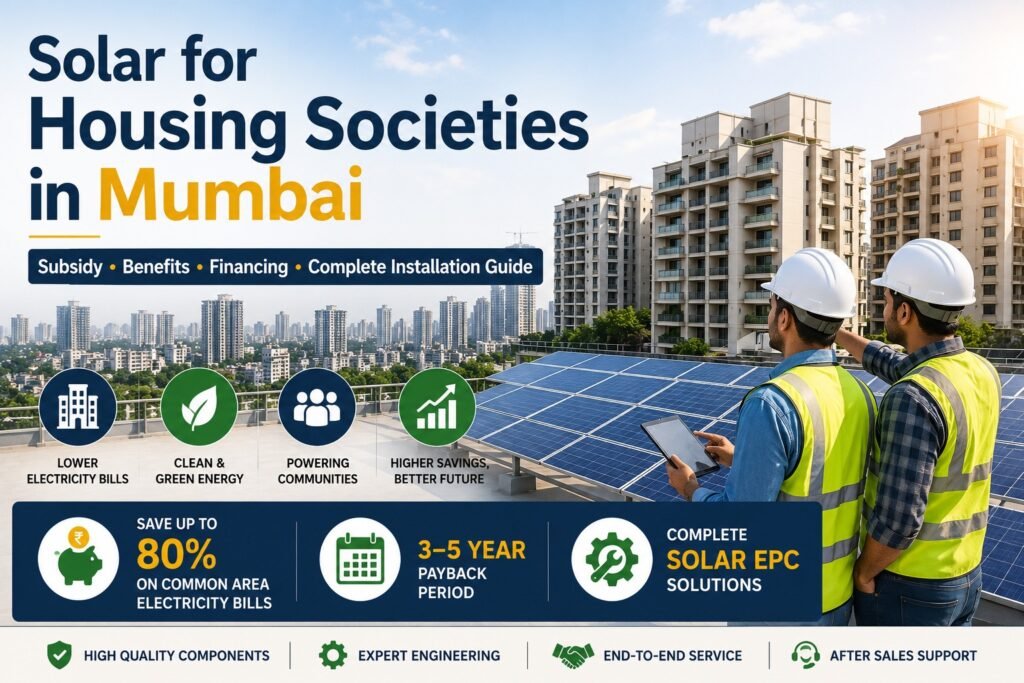
Managing electricity expenses is one of the biggest challenges for housing societies in Mumbai. Common facilities such as lifts, water pumps, parking lights, CCTV systems, clubhouses, and EV charging stations consume a significant amount of electricity every month. With electricity tariffs increasing, many housing societies in Mumbai are now switching to rooftop solar to reduce operating costs and become more energy efficient.
A well-designed solar system is not just an eco-friendly solution—it is a long-term investment that can reduce common area electricity expenses by 60–99%, generate clean energy for more than 30 years, and recover the initial investment within 2–3 years. With government support and flexible financing options, adopting solar has become easier than ever.
Why Housing Societies Should Install Solar
Housing societies in Mumbai typically consume a large amount of electricity for common amenities, including:
- Lifts
- Water pumps
- Common area lighting
- Parking lights
- CCTV surveillance
- Security cabins
- Clubhouses
- EV charging stations
Installing a rooftop solar system helps societies:
- Reduce common area electricity bills by 60–99%
- Lower monthly maintenance expenses
- Protect against rising electricity tariffs
- Increase property value
- Generate clean and sustainable energy
- Reduce dependence on conventional grid power
With solar, the money saved every month can be used for maintenance, infrastructure upgrades, or reducing maintenance charges for residents.
Government Subsidy for Housing Society Solar Projects
The Government of India promotes rooftop solar adoption through the PM Surya Ghar: Muft Bijli Yojana.
Registered Group Housing Societies (GHS) and Resident Welfare Associations (RWAs) installing solar for common facilities may be eligible for government financial assistance under the applicable scheme guidelines.
Benefits include:
- Financial assistance for eligible rooftop solar projects
- Lower upfront investment
- Faster return on investment
- Improved project affordability
Since subsidy policies may change over time, societies should always verify the latest eligibility criteria before applying.
Financing Options for Housing Society Solar Projects
Many housing societies delay solar installation because of the initial investment. Fortunately, several financing options are available.
Solar Loans
Banks and financial institutions offer solar financing that allows societies to install systems without paying the full amount upfront. In many cases, the monthly electricity savings help offset loan repayments.
CAPEX Model
Under the CAPEX (Capital Expenditure) model, the housing society makes a one-time investment to own the complete solar power system. This model offers maximum long-term savings, government incentives (where applicable), and a typical payback period of 2-3 years, with reliable performance for 30 years.
How Much Can Housing Societies Save?
The amount of savings depends on electricity consumption and system capacity.
| Monthly Common Area Bill | Estimated Monthly Savings |
| ₹50,000 | ₹30,000–₹49,000 |
| ₹1,00,000 | ₹60,000–₹99,000 |
| ₹2,00,000 | ₹1.2–₹1.99 lakh |
Most housing societies recover their investment within 2–3 years. Since solar panels generally last 30–35 years, they continue generating savings long after the investment has been recovered.
What Can a Housing Society Solar System Power?
A rooftop solar system can generate electricity for:
- Lifts
- Water pumps
- Corridor lighting
- Parking lights
- Clubhouses
- Security cabins
- CCTV cameras
- EV charging infrastructure
- Garden lighting
This reduces dependence on expensive grid electricity while ensuring uninterrupted power for common facilities.
Why Choose Rising Sun Electric?
At Rising Sun Electric, we provide complete solar EPC solutions for housing societies across Mumbai.
Our services include:
- Free rooftop assessment
- Electricity bill analysis
- Customized solar system design
- Government subsidy guidance
- Net metering assistance
- Professional installation
- Testing and commissioning
- Annual maintenance support
Every project is designed after studying your society’s electricity consumption, rooftop availability, and future energy requirements to maximize savings and long-term performance.
Key Takeaways
- Housing societies can reduce common area electricity bills by 60–99%.
- Most projects recover their investment within 2–3 years.
- Solar panels have a lifespan of 30–35 years.
- Eligible housing societies may receive government financial assistance under applicable rooftop solar schemes.
- Rooftop solar can power lifts, water pumps, lighting, CCTV systems, and other common facilities.
- Rising Sun Electric provides complete EPC services for housing societies across Mumbai.
Frequently Asked Questions
1. Is solar installation suitable for housing societies in Mumbai?
Yes. Housing societies in Mumbai are ideal for rooftop solar because common facilities such as lifts, water pumps, lighting, and CCTV systems consume electricity throughout the day. A properly designed system can reduce common area electricity expenses by 60–99%.
2. How much does solar installation cost for a housing society?
The cost depends on electricity consumption, rooftop space, and required system capacity. Most housing society projects start from 20kW and can exceed 500kW for larger residential complexes. A site inspection and electricity bill analysis help determine the right system size.
3. Is there any government subsidy available for housing societies?
Yes. Registered housing societies and RWAs may be eligible for government financial assistance under applicable rooftop solar schemes for common-area electricity usage. Eligibility depends on the latest government guidelines.
4. How much can a housing society save after installing solar?
Most housing societies can reduce common area electricity bills by 60–99%. For example, a society spending ₹1 lakh per month on electricity may save approximately ₹60,000–₹99,000 every month, depending on system size and energy usage.
5. What is the payback period for a housing society solar project?
Most rooftop solar projects recover their investment within 2–3 years. Since quality solar panels typically last 30–35 years, societies continue benefiting from reduced electricity costs for many years after the payback period.
6. How much rooftop space is required for a housing society solar system?
A rooftop solar system generally requires 50 to 60 sq. ft. of shadow-free area per kW. For example, a 50kW system typically needs around 2,500–3,000 sq. ft. of rooftop space.
7. Can rooftop solar power lifts, water pumps, and common lighting?
Yes. A properly designed solar system can offset electricity used by lifts, water pumps, corridor lighting, parking lights, CCTV systems, security cabins, and other common facilities, reducing dependence on grid electricity.
8. How long does it take to install a housing society solar system?
Installation generally takes 1 to 1.5 months, depending on project size, structural approvals, and net metering processes. Larger systems may require additional planning and coordination.
9. Does a housing society solar system require regular maintenance?
Solar systems require minimal maintenance. Cleaning the panels every 15–30 days and conducting periodic inspections helps maintain optimal efficiency. Most premium solar panels come with 30-year performance warranties.
10. Why choose Rising Sun Electric for housing society solar projects in Mumbai?
Rising Sun Electric provides complete solar EPC services, including site inspection, energy analysis, system design, installation, subsidy guidance, net metering support, and long-term maintenance. Our customized solutions help housing societies in Mumbai maximize savings, efficiency, and return on investment.
Conclusion
Rooftop solar is a smart long-term investment for housing societies looking to reduce electricity costs and improve energy efficiency. With government support, attractive financing options, and decades of reliable performance, solar delivers lasting value. Rising Sun Electric helps housing societies in Mumbai install customized solar systems with complete EPC support.

Sahil Doshi is the Director of Rising Sun Electric with over 10+ years of experience in solar energy and energy conservation. He began his professional journey in Mumbai in 2015 and has since worked on commercial, residential, and industrial solar projects.
