
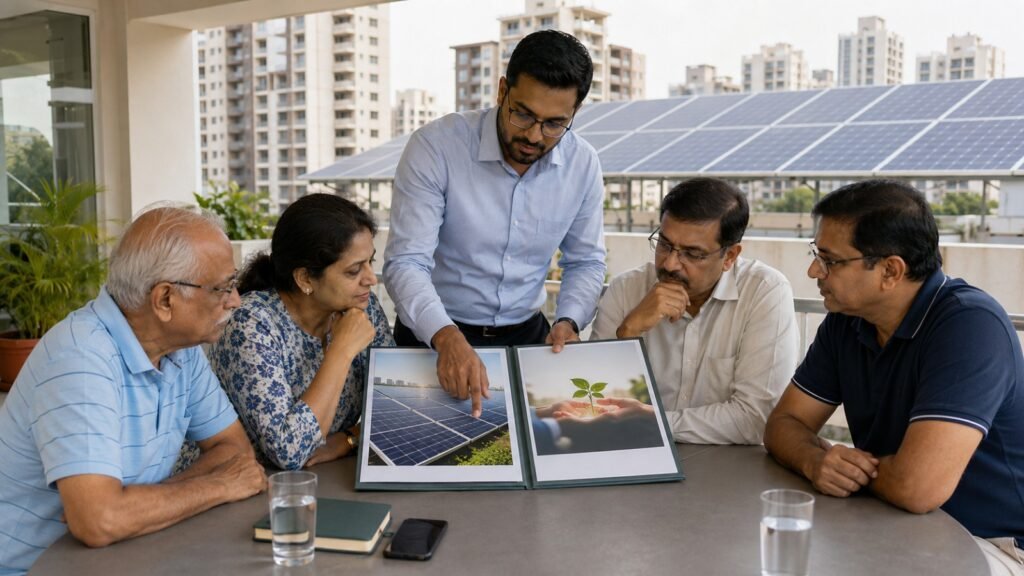
The technical design of a housing society solar project may be identical under two proposals, yet the financial outcome can be completely different. One proposal asks the society to purchase the plant. Another offers installation with little or no upfront payment in exchange for a long-term electricity agreement.
These are broadly known as CAPEX and RESCO models. The choice is not simply between paying now and paying later. It affects ownership, maintenance responsibility, control over the roof, long-term savings and the society’s ability to modify the system.
What Is the CAPEX Solar Model?
Under the CAPEX solar model, the housing society purchases and owns the rooftop solar plant. The project can be funded from the society corpus, member contributions or an approved loan. After commissioning, the society receives the electricity benefit and is responsible for operating and maintaining the asset, usually through an AMC with the EPC contractor.
Ownership gives the society control over equipment selection, maintenance standards, future expansion and vendor appointments. There is no separate solar electricity purchase contract after the plant has been paid for.
CAPEX generally suits societies that have access to funds, can approve the investment and want to retain the full long-term benefit of the plant.
What Is the RESCO Solar Model?
Under the RESCO solar model, a renewable-energy service company finances, installs, owns and operates the plant. The housing society provides rooftop access and buys the generated solar electricity under a long-term power purchase agreement.
The immediate attraction is lower upfront investment. Maintenance is usually the developer’s responsibility, and the society pays for electricity at the agreed tariff.
However, the rooftop and solar plant remain tied to the contract for many years. The society must examine tariff escalation, minimum purchase commitments, early termination, roof repair access, equipment removal, insurance, ownership transfer and performance obligations.
“Zero investment” does not mean “zero commitment.”
CAPEX vs RESCO: The Real Decision Points
Ownership and Control
CAPEX gives the society ownership from the beginning. RESCO keeps ownership with the developer during the contract period. If the society values the ability to change contractors, expand capacity or integrate future electrical upgrades, ownership may be important.
Upfront Funding
CAPEX requires capital or financing. RESCO reduces the initial burden because the developer invests. A society should compare the cost of using its corpus or taking a loan against the total payments expected under the RESCO agreement.
Long-Term Savings
In CAPEX, the society retains the electricity savings after operating expenses. In RESCO, part of the economic benefit goes to the developer through the energy tariff. The better model depends on the proposal, grid tariff, financing terms, generation estimate and contract length.
Maintenance Responsibility
A CAPEX owner must arrange panel cleaning, monitoring, preventive maintenance and repairs. This can be handled through a clear AMC. Under RESCO, the developer normally manages maintenance because revenue depends on generation, but the agreement must define response times and performance standards.
Roof Access and Building Repairs
Mumbai housing societies frequently carry out waterproofing, plumbing, lift-room work or redevelopment planning. A RESCO contract should explain who bears the cost of dismantling and reinstalling modules when the roof needs repair. Under CAPEX, the society has greater control, but it still needs a technically managed shutdown and reinstallation.
Contract and Exit Risk
CAPEX mainly involves procurement, warranties and service agreements. RESCO adds a long-term PPA and rooftop-use obligations. The committee should not sign until a legal and financial review covers tariff escalation, payment default, underperformance, force majeure, early exit and ownership at contract end.
How a Society Should Compare Proposals
Do not compare only the first-year electricity rate. Ask both bidders to use the same load data, capacity, module layout and generation assumptions. Then compare the full project period.
The committee should request a clear statement of system ownership, total society payments, maintenance scope, insurance, generation responsibility, roof-restoration clauses, equipment warranties and handover conditions.
Any housing society solar ROI claim should show the assumptions behind it. A neat percentage without bill history, degradation, downtime, financing cost and maintenance responsibility is not a decision-grade calculation.
When CAPEX Is Usually the Better Fit
CAPEX is often suitable when the society has a stable corpus, members approve the investment, the roof is unlikely to undergo major work and the committee wants maximum control. It can also work through solar financing for a housing society when loan repayment is planned against expected electricity savings.
The society should still protect itself through quality specifications, staged payments, performance testing, warranties and a maintenance plan.
When RESCO May Be Practical
RESCO can be considered when the society cannot mobilise capital but has a suitable roof and predictable electricity demand. It may allow the project to proceed without waiting for a large fund collection.
The proposal becomes practical only when the developer is financially credible and the agreement is balanced. A very low opening tariff can become expensive if escalation is aggressive or the contract restricts roof use.
Check Subsidy and Ownership Eligibility Separately
Government support and eligibility conditions can change. Some schemes are linked to the consumer owning the approved system or using specified equipment. A society should not assume that a RESCO-owned plant receives the same benefit as a CAPEX project.
The applicable portal, distribution company and scheme documents should be checked before financial comparison.
Why EPC and Financial Advice Must Work Together
The financial model cannot repair a poor engineering design. Both CAPEX and RESCO proposals require correct capacity, structural assessment, safe electrical design, approved metering and realistic generation estimates.
A reliable solar EPC company in Mumbai should explain technical assumptions clearly and avoid presenting financing as a substitute for engineering. Rising Sun Electric supports housing societies with bill analysis, rooftop survey, CAPEX planning, installation and long-term system support.
Frequently Asked Questions
Does CAPEX always provide higher savings?
CAPEX allows the owner to retain the full electricity benefit, but actual value depends on project cost, financing, generation and maintenance quality.
Is RESCO completely free for the society?
Usually there is little or no plant-purchase cost, but the society pays for solar electricity and accepts long-term contractual obligations.
Who maintains the plant under CAPEX?
The society is responsible as owner and can appoint the EPC contractor or another qualified service provider under an AMC.
Can a RESCO plant be removed for waterproofing?
The agreement should define access, dismantling, storage, reinstallation and costs. This must be resolved before signing.
Which model should a Mumbai society choose?
The answer depends on funding ability, roof plans, electricity demand, contract terms and desired control. A technical and financial comparison is necessary.
Conclusion
CAPEX offers ownership and stronger long-term control; RESCO reduces the upfront funding requirement but introduces a long contract. The better choice is the one that remains workable during roof repairs, committee changes and future electrical needs—not merely the one with the most attractive opening quotation.

Sahil Doshi is the Director of Rising Sun Electric with over 10+ years of experience in solar energy and energy conservation. He began his professional journey in Mumbai in 2015 and has since worked on commercial, residential, and industrial solar projects.
