
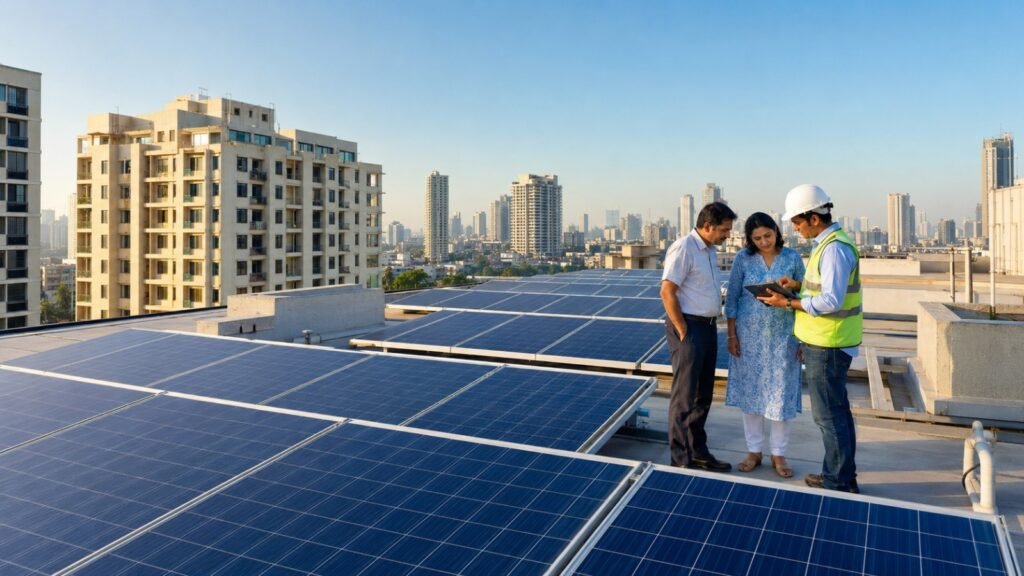
With electricity prices increasing every year, housing societies across Mumbai are actively exploring rooftop solar as a practical way to reduce common area electricity expenses. Solar panels can power lifts, water pumps, common lighting, CCTV systems, clubhouses, and other shared facilities while significantly lowering monthly electricity bills.
However, installing a solar system for a housing society is different from installing one for an individual home. It involves technical planning, approvals, structural assessment, financial evaluation, and choosing the right EPC partner. Understanding these factors before starting the project helps ensure better performance, higher savings, and a smoother installation process.
Here are ten important things every housing society should consider before investing in rooftop solar.
1. Assess Your Housing Society’s Electricity Consumption
The first step is understanding how much electricity your society consumes every month. Review at least the previous 12 months of electricity bills to identify average consumption and peak demand.
A detailed energy assessment helps determine:
- Required solar system capacity
- Expected electricity generation
- Potential monthly savings
- Return on investment
Designing a system based on actual energy usage ensures optimal performance without oversizing or undersizing the plant.
2. Check Available Rooftop Space
Not every rooftop is suitable for solar installation. A technical inspection should evaluate:
- Total shadow-free area
- Roof orientation
- Structural strength
- Existing water tanks or equipment
- Future expansion possibilities
Generally, around 50–60 sq. ft. of shadow-free rooftop space is required for every 1kW of solar capacity.
For example:
- 20kW system → 1,000–1,200 sq. ft.
- 50kW system → 2,500–3,000 sq. ft.
- 100kW system → 5,000–6,000 sq. ft.
3. Understand Government Subsidy Eligibility
Government schemes continue to encourage rooftop solar adoption for eligible residential communities.
Registered housing societies and Resident Welfare Associations (RWAs) installing solar systems for common area electricity may qualify for financial assistance under applicable government schemes.
Before proceeding, verify:
- Current subsidy guidelines
- Eligibility criteria
- Required documentation
- Application process
Working with an experienced solar EPC company simplifies this process.
4. Select the Right Solar System Capacity
Many housing societies assume that installing the largest possible system is always the best option. In reality, the ideal system size depends on:
- Monthly electricity usage
- Available rooftop space
- Budget
- Future electricity demand
For most societies:
- Small apartments: 20–30kW
- Medium societies: 50–100kW
- Large gated communities: 100–300kW or more
A customized design always delivers better financial returns than a standard package.
5. Choose High-Quality Solar Components
The quality of solar equipment directly affects system performance and lifespan.
When evaluating proposals, pay attention to:
- Solar panel efficiency
- Inverter quality
- Mounting structure durability
- Warranty terms
- Performance guarantees
Premium components generally provide reliable electricity generation for 30–3\5 years, making them a better long-term investment.
6. Evaluate Long-Term Financial Benefits
Instead of focusing only on installation cost, calculate the overall financial return.
A properly designed housing society solar system can:
- Reduce common area electricity bills by 60–99%
- Recover investment within 2–3 years
- Continue generating savings for over 30 years
The long operating life makes rooftop solar one of the most cost-effective infrastructure upgrades for residential communities.
7. Understand Net Metering
Net metering is an important part of grid-connected solar systems.
When your solar system generates more electricity than required, the excess electricity is exported to the utility grid. These exported units are adjusted against electricity consumed from the grid, helping reduce the overall electricity bill.
A solar EPC company should assist with the documentation and approval process for net metering.
8. Plan for Future Energy Requirements
Electricity demand in housing societies continues to grow due to:
- EV charging stations
- Additional lifts
- New amenities
- Increased common area lighting
- Security upgrades
If rooftop space permits, it is advisable to design the system with future expansion in mind. Scalable systems allow additional solar capacity to be added later without redesigning the entire project.
9. Consider Maintenance and Monitoring
Solar systems require very little maintenance, but regular servicing helps maintain efficiency.
A maintenance plan should include:
- Panel cleaning every 15–30 days
- Routine electrical inspection
- Inverter health monitoring
- Performance reporting
Many modern systems also include remote monitoring that allows societies to track daily electricity generation through mobile or web applications.
10. Choose an Experienced Solar EPC Company
Perhaps the most important decision is selecting the right solar installation partner.
An experienced EPC company handles:
- Site survey
- Energy assessment
- Structural evaluation
- System design
- Procurement
- Installation
- Net metering approvals
- Commissioning
- After-sales service
Choosing a company with local experience ensures smoother project execution and better long-term support.
Why Housing Societies in Mumbai Prefer Rising Sun Electric
At Rising Sun Electric, we provide complete solar EPC solutions for housing societies across Mumbai.
Our services include:
- Free site inspection
- Electricity bill analysis
- Customized system design
- Structural feasibility assessment
- Government subsidy guidance
- Net metering assistance
- Professional installation
- Annual maintenance support
Every project is designed according to your society’s electricity consumption, rooftop availability, and future energy requirements to maximize long-term savings.
Key Takeaways
- Assess electricity consumption before selecting a system size.
- Ensure sufficient shadow-free rooftop space.
- Check government subsidy eligibility.
- Invest in quality solar panels and inverters.
- Plan for future energy expansion.
- Net metering helps maximize savings.
- Solar systems can reduce electricity costs by 60–99%.
- Most housing society projects recover investment within 2–3 years.
- Quality solar panels typically perform for 30–35 years.
- Work with an experienced solar EPC company for smooth execution.
Frequently Asked Questions
1. What should a housing society check before installing solar panels?
Housing societies should evaluate electricity consumption, rooftop space, structural strength, budget, subsidy eligibility, and future energy requirements. A professional site assessment helps determine the most suitable solar system.
2. How much rooftop space is required for a housing society solar system?
A rooftop solar system generally requires 50–60 sq. ft. of shadow-free area per kW. For example, a 50kW system typically requires around 2500–3000 sq. ft. of usable rooftop space.
3. How much can a housing society save with rooftop solar?
Most housing societies reduce common-area electricity bills by 60–99%. A society spending ₹1 lakh per month on electricity can potentially save ₹60,000–₹99,000 every month, depending on system size and energy consumption.
4. What is the ideal solar system size for a housing society?
The ideal size depends on monthly electricity consumption. Small societies generally install 20–30kW, medium societies 50–100kW, while larger residential complexes may require 100–300kW or more.
5. How long does it take to recover the investment?
Most housing society solar projects achieve a payback period of 2–3 years. Since solar panels typically last 30–35 years, they continue delivering savings long after the investment has been recovered.
6. Does a housing society solar system require regular maintenance?
Yes, but maintenance requirements are minimal. Cleaning solar panels every 15–30 days and periodic inspections help maintain optimum system performance throughout the year.
7. Can housing societies expand their solar system in the future?
Yes. Many solar systems are designed to allow future capacity expansion. If sufficient rooftop space is available, additional panels can be installed as electricity demand increases.
8. Why should housing societies choose Rising Sun Electric?
Rising Sun Electric provides complete solar EPC services for housing societies across Mumbai, including energy assessment, customized system design, installation, subsidy guidance, net metering support, and long-term maintenance to maximize savings and system performance.
Conclusion
Installing rooftop solar is a smart investment for housing societies seeking lower electricity costs and long-term energy security. Proper planning, quality equipment, and expert installation make a significant difference. Rising Sun Electric delivers complete solar EPC solutions across Mumbai, helping housing societies maximize savings, efficiency, and return on investment for decades.

Sahil Doshi is the Director of Rising Sun Electric with over 10+ years of experience in solar energy and energy conservation. He began his professional journey in Mumbai in 2015 and has since worked on commercial, residential, and industrial solar projects.
